- Mon - Sat: 09:00 - 05:00
Type your paragraph here
Rahat Saleem provides legal guidance and representation for recovery of unpaid dower, also known as Haq Mehr, including review of the Nikah Nama, payment status and supporting records.
Clients from Islamabad may arrange a consultation in Rawalpindi, while online document review is available for overseas Pakistanis.
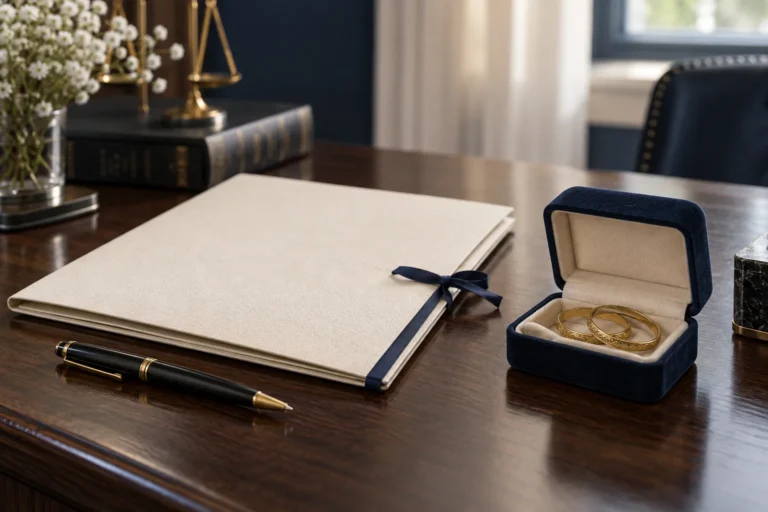
Dower or Haq Mehr is the amount, property or benefit agreed for the wife as part of the marriage and usually recorded in the Nikah Nama.
The marriage record is reviewed to confirm the dower amount and payment terms.
Receipts, bank records or other evidence may be checked to determine what remains unpaid.
Where property was agreed as dower, relevant ownership or transfer records may also be reviewed.
Where required, recovery proceedings may be pursued before the competent Family Court.
Each claim depends on the Nikah Nama, agreed Haq Mehr and available payment evidence.
The amount or property recorded as dower is identified from the marriage documents.
Available proof of payment is reviewed where payment is disputed.
Marriage, payment and property records are checked where relevant.
Where appropriate, the documents required for a recovery claim are prepared.
The procedure depends on where the marriage was registered, whether the original record is available and whether any information requires correction.
Discuss the marriage, agreed Haq Mehr and whether any amount or property has already been paid.
Review the relevant entries concerning the amount, form and payment terms of the dower.
Examine receipts, bank transfers, written acknowledgements or other records relevant to payment.
Determine what amount or property remains disputed or allegedly unpaid.
Where legal proceedings are appropriate, prepare the relevant facts, documents and relief sought.
The matter may proceed before the competent Family Court according to the applicable family-law procedure.
The exact documents depend on the nature of the dower and the dispute involved.
Not every matter requires every document. The relevant records should be identified according to the particular claim.
An overseas Pakistani may need assistance with a dower claim connected with a marriage or Family Court matter in Pakistan.
Rahat Saleem provides online consultation and document review for overseas clients.
Whether representation through an authorised person is appropriate depends on the procedural requirements of the particular matter.
The Nikah Nama may describe the dower as payable immediately, later, or according to particular terms agreed between the parties.
Where the dower is recorded as payable promptly, the timing and payment history should be reviewed against the marriage record.
Where the dower is deferred, the wording of the Nikah Nama and the circumstances affecting when payment becomes due should be examined carefully.
The actual legal effect depends on the wording of the marriage record and applicable law.
The Nikah Nama is one of the most important records in a dower dispute.
Relevant entries may include:
Total amount of Haq Mehr
Amount paid at the time of marriage
Amount remaining unpaid
Prompt or deferred terms
Description of property or another asset
Additional conditions concerning payment
The Nikah Nama should be reviewed carefully before the amount recoverable is assessed.
Pakistan’s Muslim Family Laws framework also recognises dower as part of the registered Nikah documentation, including situations where dower may consist wholly or partly of property rather than money.
Where Haq Mehr is expressed as a monetary amount, the dispute may concern:
Whether payment was made
How much was paid
When payment was made
Whether part of the amount remains outstanding
Whether there is written proof of payment
Whether the parties dispute the terms recorded in the Nikah Nama
Bank records, receipts and written acknowledgements may be relevant to the assessment.
Dower is not necessarily limited to cash. It may also involve property or another agreed asset.
Where property is recorded as Haq Mehr, relevant documents may include:
Nikah Nama
Property description
Title documents
Registry records
Mutation records
Transfer documents
Possession information
Any subsequent agreement between the parties
The legal position should be assessed from both the marriage record and the property documentation.
Dower issues may arise during or after divorce, Khula or other dissolution proceedings.
Relevant questions may include:
What amount was originally agreed?
What amount has already been paid?
Is any balance outstanding?
What does the Nikah Nama record?
Has any settlement already been reached?
Are there court orders dealing with the dower?
Is the matter linked to Khula or another dissolution claim?
Dower should be considered separately from other family-law claims unless they are being dealt with together in the same proceedings.
A dower recovery matter may arise alongside other family-law issues.
These may include:
Maintenance
Recovery of dowry articles
Recovery of bridal gifts
Divorce or Khula
Child custody
Child maintenance
Restitution of conjugal rights
Each claim should be supported by its own relevant facts and documentation.
A dispute may arise where the husband maintains that the dower has already been paid while the wife disputes that position.
The available evidence should be reviewed, including:
Nikah Nama entries
Receipts
Bank records
Written acknowledgements
Messages or correspondence
Witness-related information where relevant
Property-transfer documents where applicable
The legal position depends on the documentary and other evidence available.
Before taking further legal steps, it is useful to confirm:
What amount or property was agreed as Haq Mehr?
What does the Nikah Nama record?
Was any portion paid at the time of marriage?
Is the dower prompt or deferred?
Is payment disputed?
What evidence exists regarding payment?
Is property involved?
Is a divorce or Khula case already pending?
Have any previous court orders been passed?
These details help identify the appropriate legal approach.
Advice and representation where bridal gifts or related property are disputed.
Legal guidance and representation concerning maintenance claims.
Contact Rahat Saleem, Advocate High Court, for legal guidance and representation concerning Haq Mehr, unpaid dower and related Family Court matters in Rawalpindi.
Clients from Islamabad may arrange a consultation at District Bar Rawalpindi. Online consultations are also available for overseas Pakistanis who need their Nikah Nama and supporting records reviewed before taking further legal steps in Pakistan.
Legally reviewed by Rahat Saleem, Advocate High Court
Advocate High Court | District Bar Rawalpindi
Family Law Services – Rawalpindi
This page provides general information concerning recovery of dower and Haq Mehr in Pakistan. It does not constitute legal advice for any particular marriage or claim. Entitlement, payment obligations, recoverable amount, procedure and available remedies depend on the Nikah Nama, evidence, facts and applicable family law.