- Mon - Sat: 09:00 - 05:00
Type your paragraph here
Rahat Saleem provides guidance and coordination for Online Nikah matters involving clients in Pakistan and overseas, including review of identity documents, marriage details and documentation relevant to registration in Pakistan.
An Online Nikah may be arranged where one or both parties are unable to attend the same location in person. The appropriate process depends on the parties’ circumstances, consent, identity documents, witnesses, representation arrangements where applicable and the requirements for registering the marriage.
Online consultation and document review are available for overseas Pakistanis who require guidance before arranging their Nikah in Pakistan.
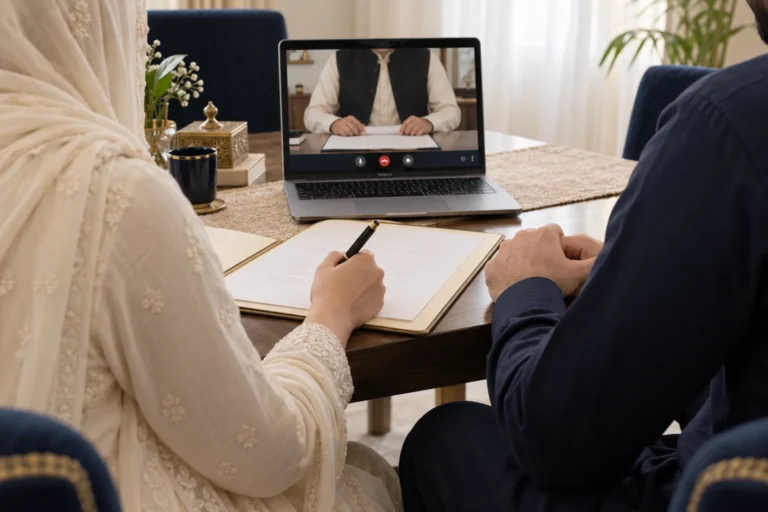
An Online Nikah is a Nikah arrangement in which one or both parties participate remotely or act through an authorised representative where legally and religiously appropriate.
The process should satisfy the requirements applicable to the Nikah, including clear consent of both parties, Ijab-o-Qabool, agreed Meher and the required witnesses.
Where a party cannot participate personally in the relevant formalities, a Wakeel or authorised representative may be used according to the circumstances and applicable requirements.
CNIC, NICOP or passport information of the bride and groom is reviewed before the Nikah arrangements proceed.
The parties’ consent, personal information and agreed Meher are confirmed for preparation of the marriage documentation.
The arrangements for remote participation, witnesses and representation are considered according to the circumstances.
Guidance is provided concerning the Nikah Nama, registration and subsequent marriage documentation.
Every Online Nikah depends on the location and circumstances of the bride and groom and the documents available to them.
Rahat Saleem reviews the information and supporting records before explaining the documentation and registration steps relevant to the proposed marriage.
The exact requirements depend on the circumstances, but an Online Nikah may involve several important elements.
The bride and groom should provide clear and free consent to the marriage.
The offer and acceptance forming part of the Nikah should be clearly expressed according to the applicable requirements.
The parties should agree on the Meher or dower to be recorded as part of the marriage documentation.
Witness arrangements should satisfy the applicable requirements for the Nikah.
The bride and groom’s identity information should be verified against their available CNIC, NICOP or passport records.
The reference material similarly identifies consent, agreed Meher and two adult Muslim witnesses as core elements of its Online Nikah process.
The exact process depends on whether both parties participate remotely or whether a representative is involved.
Discuss the proposed marriage, current location of both parties and available documentation.
Provide copies of CNIC, NICOP, passport and other relevant records for review.
Confirm the parties’ names, addresses, marital status, Meher and other information required for the Nikah Nama.
Determine how the bride and groom will participate and whether a Wakeel or authorised representative is required.
The Nikah may be arranged through an agreed video-call or remote-participation method according to the circumstances.
The relevant Nikah Nama and supporting information are completed following the ceremony.
The Nikah documentation is then processed through the applicable registration procedure.
The reference describes a broadly similar sequence: obtaining the parties’ particulars and consent, arranging a video-call ceremony, conducting Ijab-o-Qabool with witnesses, and then proceeding with registration documentation.
The exact documents depend on the parties’ circumstances and location.
The reference similarly identifies CNIC or passport copies, previous divorce or death records where relevant, witness identity information and contact details among the documents used for Online Nikah arrangements.
Online Nikah can be particularly useful where one or both parties live outside Pakistan and cannot conveniently attend a marriage ceremony in Pakistan in person.
Rahat Saleem provides online consultation and document review for overseas clients.
Whether an application can be completed through an authorised representative depends on the existing marriage record and the requirements of the issuing authority. Completion without travel should not be promised before these requirements are confirmed.
Where either party has previously been married, additional documentation may be required to confirm their current marital status.
The appropriate documentation depends on how the previous marriage ended and the records available.
Where one party is in Pakistan and the other lives overseas, the documentation and participation arrangements should be clarified before the Nikah.
Important issues may include:
Location of the bride
Location of the groom
Nationality and identity documentation
Ability to participate remotely
Consent
Witness arrangements
Meher
Wakeel or representative arrangements
Registration of the Nikah
Intended use of the marriage documents abroad
The correct arrangement depends on the particular circumstances.
Where both the bride and groom are living outside Pakistan, additional questions may need to be considered before arranging registration in Pakistan.
These may include:
Pakistani citizenship or identity documentation
Place where the marriage is intended to be registered
Availability of CNIC or NICOP
Witness arrangements
Representation in Pakistan where required
Foreign-national documentation where relevant
Future immigration or spouse-visa use
Attestation or translation requirements
The requirements should be confirmed before the ceremony and registration arrangements are finalised.
Where one of the parties cannot personally perform the relevant formalities, an authorised representative or Wakeel may be involved according to the applicable legal and religious requirements.
The authority should clearly identify:
The person granting authority
The appointed Wakeel or representative
The intended marriage
The authority being granted
Relevant personal details
Any specific limitations or conditions
Where a formal Power of Attorney or other authorisation is required, execution and attestation requirements should be confirmed according to the location of the person granting authority.
The Nikah Nama is an important record of the marriage and should be completed carefully.
Information may include:
Bride’s full name
Groom’s full name
CNIC, NICOP or passport information
Addresses
Marriage date
Meher
Witness information
Nikah Registrar information
Relevant marriage conditions
Delegated right of divorce where applicable
Other information required by the prescribed Nikah Nama
The information should correspond with the identity documents supplied by both parties.
The Nikah ceremony and official marriage registration are connected but should not be treated as exactly the same step.
The parties provide consent and complete the religious marriage requirements.
The prescribed marriage contract records the relevant details of the marriage.
The Nikah Nama is processed through the appropriate registration system and local authority.
Following proper registration, a computerized Marriage Registration Certificate may be required for legal or administrative purposes.
The reference similarly distinguishes the Nikah ceremony from subsequent registration and marriage-certificate documentation.
Depending on the purpose of the marriage documentation, the parties may later require:
Registered Nikah Nama
Copies of the Nikah Nama
Marriage Registration Certificate
Certified translation of the Nikah Nama
MOFA attestation where required
Embassy or consular legalization where required
Other supporting documentation requested by a foreign authority
Not every couple requires every document.
An Online Nikah may involve a Pakistani citizen marrying a foreign national.
Such matters may require additional review of:
Foreign passport
Pakistani CNIC or NICOP of the Pakistani party
Current marital status of both parties
Foreign identity documents
Marriage-registration requirements
Translation requirements
Documents required by the foreign party’s country
Immigration or visa requirements after marriage
The exact requirements depend on the nationalities and circumstances of the parties.
Couples living abroad may require Pakistani marriage documents for:
Spouse visa applications
Family visa matters
Immigration
Residence applications
Foreign civil registration
Family-record updates
Embassy procedures
Other administrative purposes
Depending on the destination country, further documentation may be required.
This can include:
Certified translation
MOFA attestation
Apostille where applicable
Embassy legalization
Registration with a foreign civil authority
Recognition requirements should be confirmed with the foreign authority that will receive the marriage documents.
The reference also cautions that requirements for domestic legal recognition abroad can differ by country and purpose.
Where marriage records are to be used outside Pakistan, a foreign authority may request a translated version of the Nikah Nama or related marriage record.
Before obtaining a translation, it is useful to confirm:
Required language
Whether certification is required
Whether notarisation is required
Whether MOFA attestation is required
Whether embassy legalization is required
The receiving authority’s requirements should be checked before documents are prepared.
Where an Online Nikah has already taken place, the available records can be reviewed before registration or overseas use.
The review may include:
Bride and groom names
CNIC, NICOP or passport numbers
Marriage date
Meher information
Witness details
Wakeel information where applicable
Nikah Registrar information
Registration details
Missing information
Apparent inconsistencies
Incorrect information should be identified before the records are relied upon for subsequent legal or administrative purposes.
The document commonly referred to as a NADRA Marriage Certificate is connected with the registered civil record of the marriage.
The underlying Nikah Nama remains an important marriage record.
Records the marriage contract
Contains the parties’ information
Records Meher and agreed terms
Includes witness information
Forms the basis for marriage registration
Provides a computerized civil marriage record
Uses information from the registered marriage record
May be required for legal or administrative purposes
May be required for overseas use
The details on both records should be checked for consistency.
Before proceeding, it is useful to confirm:
Where the bride is located
Where the groom is located
Nationality of each party
CNIC, NICOP or passport availability
Current marital status
Agreed Meher
Witness arrangements
Whether a Wakeel is required
Where the marriage will be registered
Why the resulting documents will be needed
Reviewing these matters beforehand can help identify missing documentation early.
Guidance concerning marriage arrangements and documentation for couples marrying in Pakistan.
Guidance concerning registration of a Nikah and preparation of the relevant records.
Contact Rahat Saleem, Advocate High Court, for guidance concerning Online Nikah arrangements, identity-document review and marriage registration in Pakistan.
Clients in Rawalpindi and Islamabad may arrange a consultation, while overseas Pakistanis can provide their available documents electronically for review before proceeding.
Legally reviewed by Rahat Saleem, Advocate High Court
Advocate High Court | District Bar Rawalpindi
Marriage & Nikah Services – Rawalpindi
This page provides general information concerning Online Nikah and related marriage documentation in Pakistan. It does not constitute legal advice for any particular marriage. Eligibility, religious requirements, representation, witnesses, registration, foreign-national documentation and overseas recognition depend on the parties’ circumstances and applicable requirements.